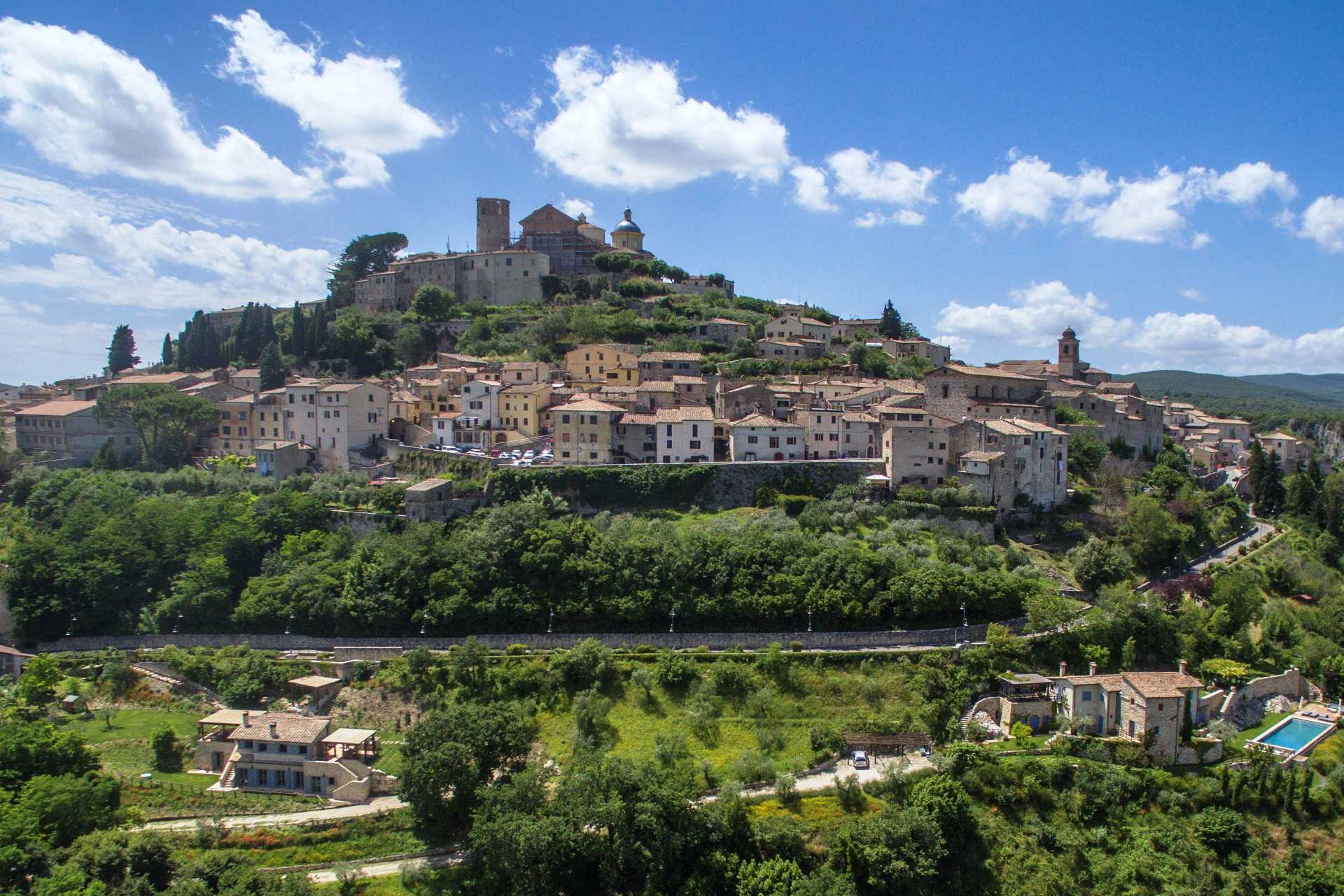
Amelia: Umbria's untouched medieval gem for film productions
Amelia offers film and photography productions one of Italy's most authentic medieval settings with pre-Roman walls dating to the 6th century BC , remarkably preserved Renaissance architecture, and crucially, minimal tourist interference compared to other Umbrian destinations. Located just 1 hour 20 minutes from Rome Fiumicino Airport and strategically positioned in southern Umbria, this hilltop town provides production teams with both exceptional historical authenticity and modern logistical convenience. The combination of 2,000-year-old polygonal walls, intact medieval streets, and established film infrastructure through the Umbria Film Commission makes Amelia an increasingly valuable location for period productions seeking alternatives to overcrowded Tuscan destinations.
Ancient borgo preserves 2,600 years of architectural layers
The historic center of Amelia represents one of Europe's most complete examples of continuous urban occupation from pre-Roman through medieval periods. The famous Mura Poligonali stretch over 2 kilometers around the town , constructed between the 6th and 4th centuries BC using massive limestone blocks fitted without mortar in cyclopean masonry technique. These walls reach heights exceeding 6 meters with thickness of 3.5 meters , creating a dramatic backdrop unmatched elsewhere in central Italy. The exceptional preservation state means production teams can film 800 meters of prime polygonal stonework extending from Porta Romana, with the ancient construction adapting organically to topographical contours.
Medieval Amelia layers perfectly atop these ancient foundations through a network of narrow stone alleys (vicoli) that maintain their original patterns. The Torre Civica rises 30 meters with its distinctive dodecagonal design symbolizing the twelve months, while noble palazzos line the main streets. Palazzo Farrattini, designed by Antonio da Sangallo il Giovane between 1520-1525, serves as a miniature prototype of Rome's Palazzo Farnese. The Cathedral of Santa Fermina, originally built in 872 AD and rebuilt after a 1640 fire, anchors Piazza del Duomo alongside the Bishop's Palace and Seminary. Throughout the centro storico, authentic wooden doors with original hardware mark entrances to medieval buildings, while Gothic and Renaissance window frames with stone tracery remain intact on palace façades.
The urban layout preserves its medieval structure through interconnected piazzas and steep topography creating multiple elevation levels. Via della Repubblica follows the Roman decumanus with original pavement sections still visible , while smaller alleys branch into intimate spaces perfect for controlled filming. Piazza Marconi features the Loggia del Banditore, a medieval herald's tribune, while Piazza Matteotti sits above Roman cisterns accessible for underground scenes. This authentic stratification provides production designers with ready-made period settings requiring minimal set dressing.
Strategic location connects major airports within two hours
Amelia's position in southern Umbria provides exceptional access from Italy's major transportation hubs while maintaining rural authenticity. Perugia San Francesco d'Assisi Airport sits just 61 kilometers away (45 minutes to 1 hour drive), offering the closest air connection with regional flights primarily through Ryanair. Rome Fiumicino, Italy's primary international gateway, lies 121-126 kilometers south via the A1 Autostrada, providing a comfortable 1 hour 20 minute transfer for international crews and equipment. Rome Ciampino offers an even closer option at 86 kilometers (1 hour 10 minutes), particularly convenient for charter flights and smaller aircraft.
Florence Peretola Airport requires 171 kilometers of travel (1 hour 45 minutes to 2 hours) via the A1 and E45 highways, while major cities provide equally accessible connections. Rome city center sits 92 kilometers away (1 hour 20 minutes), Perugia at 83 kilometers (approximately 1 hour 15 minutes), and Orvieto just 47 kilometers (40-50 minutes). The nearest train station at Narni-Amelia, 10 kilometers from town, offers regional connections to Rome Termini in 58 minutes with 5-17 daily services. Production vehicles access Amelia primarily through the A1 Autostrada to Orte exit , then local roads, with toll costs from Rome approximately €8-12. The E45 European route provides an alternative north-south corridor through Umbria, particularly useful for equipment coming from Perugia or Florence.
Production logistics benefit from established infrastructure
Film crews find practical support through the Umbria Film Commission, established in March 2021 , which coordinates permits, locations, and local services from offices in Perugia. The commission maintains databases of registered local professionals and technical workers, developed through successful productions like the long-running "Don Matteo" television series filmed throughout the region. Municipal permits require submission to Comune di Amelia at Piazza Matteotti , while historic monuments need additional authorization from the Soprintendenza Archeologia, Belle Arti e Paesaggio per l'Umbria in Perugia, currently experiencing staff shortages requiring extra lead time.
Parking for production vehicles concentrates around Porta Romana , the main southern entrance, with additional staging possible at Piazza Matteotti near the town hall. The historic center's narrow medieval streets restrict large vehicle access, requiring coordination with municipal police for equipment transport through the ancient gates. Crew accommodation centers on Hotel Anita's 24 rooms located 5 minutes from Porta Romana, while Monastero Le Grazie offers 15 apartments in a converted Cistercian monastery 10 minutes from the centro storico. Equipment rental companies Terminal Production and ORBIS serve the region from Rome and Florence bases, providing full camera, lighting, and grip packages with English-speaking crews available.
Historic architecture serves period productions across centuries
Amelia's architectural diversity spans 2,600 years of continuous occupation, offering production designers authentic backdrops from prehistoric through Renaissance periods. The pre-Roman walls provide Europe's most significant example of polygonal construction still standing, their massive limestone blocks creating dramatic compositions for ancient world productions. Ten interconnected Roman cisterns beneath Piazza Matteotti, with 4,300 cubic meter capacity , offer underground filming opportunities with controlled access through guided tours. The Archaeological Museum houses the remarkable 2-meter bronze statue of Germanicus from the 1st century AD, while Roman bath remains with original mosaics lie beneath Palazzo Farrattini.
Medieval elements dominate the streetscape through the Cathedral complex, San Francesco Church begun in 1287 with its Gothic façade and double-wheel rose window from 1401, and Sant'Agostino featuring a 13th-century Romanesque-Gothic façade. Noble residences showcase Renaissance sophistication, particularly Palazzo Petrignani's Sala dello Zodiaco with extensive frescoes and Palazzo Venturelli incorporating underground Roman mosaics. The Teatro Sociale from 1792, constructed as a prototype for Venice's La Fenice, maintains fully functional period mechanisms. This layering allows directors to capture multiple historical periods within walking distance, from cyclopean walls through medieval fortifications to Renaissance palaces, all maintaining authentic patina and minimal modern intrusions.
Previous productions establish filming credentials
While Amelia itself maintains lower profile than neighboring locations, the surrounding region has proven production value through multiple successful projects. The television series "Don Matteo" extensively filmed throughout southern Umbria including Carsulae, Amelia, Narni, Terni, and Avigliano Umbro, establishing local crew expertise and production infrastructure. HBO's "My House in Umbria" (2003) starring Maggie Smith and Chris Cooper utilized Umbrian locations for its period setting. More recently, the Amanda Knox limited series for Hulu filmed in nearby Orvieto and Perugia in 2024 , demonstrating continued international interest in the region's authentic Italian atmosphere.
The area's low tourist numbers compared to Tuscany provide significant advantages for controlled filming environments. Multiple sources confirm Amelia receives far fewer visitors than Assisi's 6 million annually or the tour bus crowds in Orvieto and Spello. Travel guides consistently describe the town as "secret," "off tourist routes," and "not usually on tourist routes," with infrastructure primarily serving residents rather than commercial tourism. This authentic local atmosphere translates directly to screen, avoiding the sanitized feeling affecting more commercialized historic centers.
Optimal filming spans April through October
Mediterranean climate patterns make April-June and September-October the premium filming periods , combining comfortable temperatures of 15-26°C with 6-8 hours daily sunshine and moderate rainfall. Summer peaks in July-August bring intense heat up to 32°C but offer maximum daylight with sunrise at 5:32 AM and sunset at 8:52 PM during the solstice. Winter months from December through February present challenges with temperatures dropping to 2-11°C and rainfall reaching 120-140mm monthly, though dramatic lighting angles and extended golden hours provide unique atmospheric opportunities.
The hilltop location at 1,076 feet elevation creates beneficial microclimate conditions , positioning Amelia above valley fog 80% of winter mornings while providing 3°C cooler temperatures than valley locations during summer heat. Golden hour quality reaches peak aesthetics during spring and autumn equinoxes, with September offering sunrise between 6:44-7:06 AM and sunset from 7:30-6:54 PM. The "Golden Heart" light characteristic of central Italy provides warm, honeyed tones with color temperatures ranging from 2,700K at sunrise/sunset to 5,500K midday. Weather predictability rates 85-90% confidence during optimal months , superior to coastal locations affected by sea breezes or Rome's urban heat island effects.
Local regulations require advance permit coordination
Production permits follow standard Italian protocols with specific local requirements. The Comune di Amelia (telephone +39 0744 9761, email comune.amelia@postacert.umbria.it) processes municipal permits for public spaces, streets, and piazzas, requiring minimum 5 working days advance notice though 2-3 weeks proves more realistic. The Soprintendenza in Perugia (email sabap-umb@pec.cultura.gov.it) must approve filming at historic monuments and archaeological sites, currently experiencing staffing shortages necessitating extra lead time. Fees vary based on location sensitivity, production size, area occupation, and duration, with security deposits potentially required for particularly sensitive historic locations.
Limited Traffic Zones (ZTL) in the historic center restrict vehicle access similar to other Italian cities, with goods delivery typically permitted 8:00-11:00 and 15:00-18:00. Production vehicles require special authorization from local police, coordinated through the Umbria Film Commission which provides comprehensive support including location databases, permit assistance, local crew coordination, and guidance on regional financial incentives. The commission's establishment in 2021 by Umbria Region, Municipality of Perugia, Municipality of Terni, and ANCI Umbria demonstrates regional commitment to supporting film production.
Southern Umbria multiplies location options within 40 minutes
Amelia's strategic position provides access to diverse complementary locations within practical daily driving distance. Narni, just 8 kilometers south , offers a completely preserved medieval fortress town with underground passages, Roman cistern, and Inquisition torture rooms, plus the imposing 14th-century Albornoz Fortress commanding the Nera River valley. The dramatic Ponte d'Augusto Roman bridge ruins provide additional period atmosphere, while the town's connection as C.S. Lewis's inspiration for Narnia adds cultural resonance.
Natural features include the spectacular Cascata delle Marmore 30 kilometers northeast , the world's tallest man-made waterfall at 165 meters created by Roman engineers in 271 BC. The three-tier cascade with controlled water flow can be activated for filming with advance arrangement. Lake Corbara , 35 kilometers northwest, spans 10-13 square kilometers surrounded by vineyards and olive groves, with the dramatic Forello Gorges featuring 200-meter limestone cliffs. The complete Roman city ruins at Carsulae , 25 kilometers away, preserve theater, amphitheater, forum, and basilica along the original Via Flaminia with minimal modern intrusion.
Medieval villages within 30 minutes include Lugnano in Teverina (11 kilometers), designated one of Italy's "Most Beautiful Villages" with its magnificent Romanesque Collegiate Church and 16th-century Palazzo Farnese-Ridolfi. Renaissance fortresses like Castello di Alviano (15 kilometers) provide authentic castle settings with trapezoidal plans, four towers, and frescoed chapels. The Amerini Mountains region offers traditional olive groves, DOC vineyards, and cypress-lined country roads representing classic Umbrian countryside. This concentration of varied locations allows productions to capture multiple settings and periods while maintaining single base operations, maximizing shooting efficiency within the renowned "green heart of Italy."
download full scouting pdf
Download our comprehensive scouting guide in PDF format, featuring a curated selection of top photo and video locations in Amelia, Umbria. Explore charming streets, iconic landmarks, and picturesque public spaces ideal for street, editorial, and automotive shoots. With detailed insights and recommendations, our scouting guide ensures a seamless experience for photographers and videographers seeking the perfect backdrop for their projects.