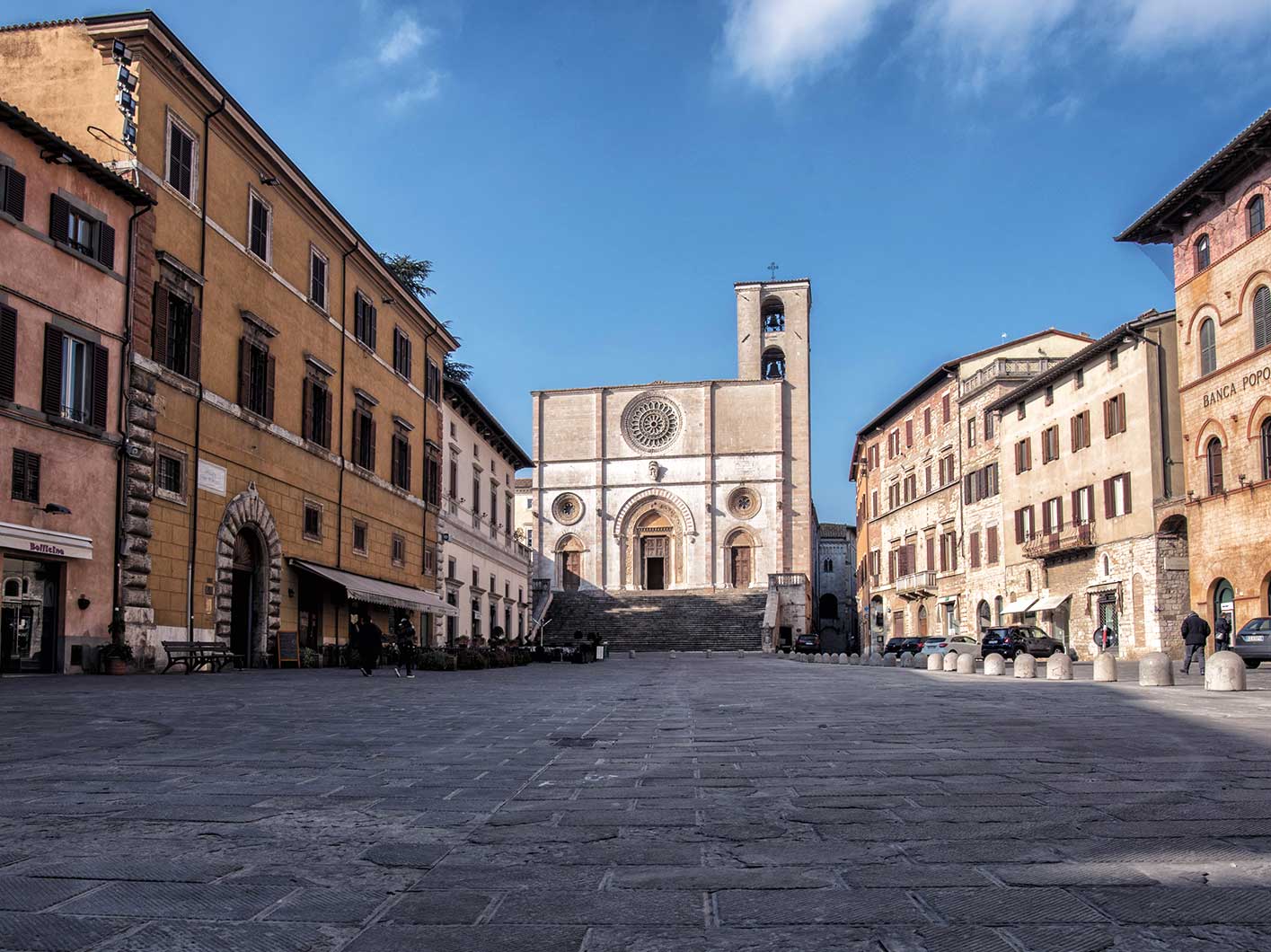
Todi offers production teams one of Italy's most perfectly preserved medieval town centers, with its spectacular Piazza del Popolo ranking among Europe's finest medieval squares and authentic stone architecture untouched by mass tourism. Located just 1 hour 40 minutes from Rome Fiumicino Airport , this hilltop town provides exceptional period authenticity while maintaining practical accessibility for international crews. The combination of intact 13th-century civic palaces, minimal tourist interference, and established film infrastructure through previous productions like "The Agony and the Ecstasy" makes Todi an increasingly valuable alternative to overcrowded Tuscan locations. With dramatic panoramic views across the Tiber Valley and complete medieval streetscapes requiring minimal set dressing, Todi delivers production value that rivals any location in central Italy.
Medieval piazza creates ready-made period film set
Piazza del Popolo represents one of Europe's most architecturally cohesive medieval squares, with its ensemble of 13th-century civic buildings creating an authentic period environment unmatched in central Italy. The Palazzo del Popolo (1213-1233) dominates the northern side with its distinctive Lombard-Gothic architecture, featuring the original external staircase and crenellated tower that served as Todi's seat of communal power. Directly adjacent, the Palazzo del Capitano from the late 13th century showcases Gothic triple-light windows and maintains its original stone facade, while the Palazzo dei Priori completes the civic complex with its 14th-century trapezoidal tower.
The piazza's authentic medieval paving stones remain intact across its 2,800 square meters, sloping gently toward the Duomo to create natural dramatic angles for filming. Original stone benches line the perimeter beneath covered loggias that provide controlled lighting opportunities throughout the day. The square's elevation at 400 meters above sea level positions it above morning valley fog while maintaining clear sightlines in every direction, crucial for period productions requiring unobstructed backgrounds.
This remarkable preservation extends beyond mere facades - the piazza functions as a living medieval space with minimal modern intrusions. Electrical cables run underground, contemporary signage remains strictly regulated, and the absence of chain stores maintains authentic storefronts suitable for period dressing. The square's proven film pedigree includes serving as St. Peter's Square circa 1508 for "The Agony and the Ecstasy" (1965), demonstrating its versatility for representing various Italian Renaissance settings.
Strategic location balances accessibility with authenticity
Todi's position in southern Umbria provides exceptional logistical advantages while maintaining the authentic atmosphere productions require. Rome Fiumicino Airport lies just 101 miles south via the A1 Autostrada, offering a comfortable 1 hour 42 minute transfer for international crews and equipment. The route follows modern highways for 90% of the journey before transitioning to provincial roads for the final approach, ensuring reliable access even with heavy production vehicles.
Alternative airports expand options for European crews, with Perugia San Francesco d'Assisi Airport just 40 kilometers north (45-50 minutes) providing regional connections through Ryanair. Florence Airport requires a 2 hour drive via the A1, while Rome Ciampino offers another option at similar distance to Fiumicino. This multi-airport accessibility proves particularly valuable for flying in specialized crew or talent from different European locations.
The town maintains regular transportation links despite its hilltop location. Sulga Autolinee operates three daily direct buses from Rome Fiumicino Airport to Todi (3-hour journey), eliminating the need for immediate vehicle rental. The nearest train station at Ponte Rio (8 kilometers) connects to Rome Termini via Terni, though most productions prefer the flexibility of vehicle transport. Local roads accommodate production trucks and equipment vehicles, with designated parking areas at Porta Romana and Porta Perugina providing staging zones outside the historic center.
Production infrastructure supports international crews
Film productions benefit from Todi's established infrastructure developed through decades of hosting international projects. The town's experience dates back to major Hollywood productions, creating a local understanding of film industry requirements. Municipal authorities coordinate through the Comune di Todi (Piazza del Popolo, 29) , with established procedures for location permits typically processed within 5-7 working days. The local film office maintains relationships with property owners accustomed to location agreements, streamlining access to private palazzos and gardens.
Crew accommodation centers on several production-friendly hotels within the historic center. Hotel Bramante offers 51 rooms in a converted convent with parking for production vehicles, while Hotel San Lorenzo provides 6 intimate rooms directly on Via San Lorenzo with period interiors suitable for small unit filming. For longer productions, Torre Sangiovanni offers apartment rentals with kitchen facilities in a 13th-century tower, allowing for extended stays. Additional options in nearby Massa Martana and Collevalenza expand capacity for larger crews.
Equipment and technical support arrive primarily from Rome, with established vendors providing full camera, lighting, and grip packages with 2-hour delivery. Local production services include location managers familiar with Umbrian bureaucracy, Italian-English interpreters, and casting coordinators with access to local talent pools. The town's compact size means all locations remain within 10-minute walks, maximizing shooting efficiency and minimizing transport requirements between setups.
Architectural diversity spans Roman through Renaissance periods
Todi's 2,400-year continuous occupation creates exceptional architectural stratification rarely found in single locations. The Roman heritage manifests through the preserved amphitheater remains beneath Piazza Garibaldi, accessible for controlled filming of underground sequences. Original Roman cisterns, particularly the Cisterne Romane beneath Via del Monte, provide atmospheric subterranean spaces with vaulted ceilings ideal for period dungeon or catacomb scenes.
Medieval architecture dominates the streetscape through perfectly preserved examples across multiple centuries. The Cathedral of Santa Maria Annunziata , begun in the 12th century, features a Romanesque facade with Gothic modifications and Renaissance additions, allowing directors to capture multiple period styles within single frames. San Fortunato Church (1292) showcases pure Gothic architecture with its unfinished facade creating dramatic compositional opportunities, while the church's 153-step campanile provides elevated shooting positions with 360-degree views.
Renaissance refinement appears in the Temple of Santa Maria della Consolazione (1508-1607) , positioned strategically outside the walls as one of Italy's finest Renaissance churches. Designed by Cola da Caprarola and possibly Bramante, its perfect Greek cross plan with central dome provides iconic establishing shots. Within the town, Palazzo Ludovico Atti features sophisticated Renaissance details, while numerous noble residences display period frescoes, coffered ceilings, and original architectural elements suitable for interior period scenes.
Previous productions establish filming credentials
Todi's filmography demonstrates consistent appeal to international productions seeking authentic Italian settings. The town's breakthrough came with Carol Reed's "The Agony and the Ecstasy" (1965) , where Piazza del Popolo doubled as St. Peter's Square for scenes between Charlton Heston's Michelangelo and Rex Harrison's Pope Julius II. The production's success established Todi's reputation for providing grand Renaissance backdrops while maintaining practical shooting conditions.
More recently, "Welcome Home" (2018) utilized Todi extensively, filming at Old Time Snc antique store on Via Giuseppe Mazzini and throughout the medieval streets for this psychological thriller starring Aaron Paul and Emily Ratajkowski. The production demonstrated Todi's versatility for contemporary narratives while showcasing its atmospheric medieval ambiance. Specific locations included Via Giuseppe Mazzini for street scenes and the renowned Cantina Peppucci winery in nearby Petroro for villa sequences.
Television productions have also discovered Todi's potential, with various Italian series utilizing the town for period episodes. The proximity to other Umbrian locations like Spoleto (used for "Don Matteo" series) and Orvieto creates opportunities for multi-location shoots within practical daily distances. This established production history means local businesses understand filming requirements, from early morning starts to street closures, facilitating smoother operations than virgin locations.
Minimal tourism preserves authentic atmosphere
Unlike heavily touristed Tuscan hill towns, Todi maintains authentic local character essential for believable period productions. The town receives a fraction of visitors compared to San Gimignano or Montepulciano, with most tourists concentrated during brief summer peaks. Travel guides consistently describe Todi as "off the beaten track" and "underrated," indicating minimal commercial tourism infrastructure that would complicate filming.
This low tourist density translates directly to production advantages. Streets remain uncrowded even during peak seasons, eliminating the need for extensive crowd control. Local businesses cater primarily to residents rather than tourists, maintaining authentic storefronts and traditional operations suitable for background atmosphere. The absence of tour buses means production vehicles can access locations without competing for limited parking, while the lack of tourist-oriented signage reduces location preparation requirements.
The town's designation as "the most livable city in the world" by architect Richard Levine in 1991 reflects its focus on quality of life over tourism revenue. This priority maintains the genuine Italian hill town atmosphere productions seek, with locals conducting daily life in centuries-old patterns. Markets operate in traditional rhythms, elderly residents gather in piazzas for evening passeggiata, and authentic neighborhood life continues undisturbed by tourism's commercial pressures.
Natural lighting maximizes production hours
Todi's elevated position creates exceptional natural lighting conditions throughout shooting days. The hilltop location at 400 meters provides unobstructed eastern and western exposures , delivering quality dawn light from 5:30 AM in summer and dramatic sunset illumination until 8:30 PM. The absence of tall modern buildings ensures consistent natural light reaches all historic areas, reducing dependence on artificial lighting for daylight exteriors.
The town's orientation maximizes the famous Umbrian "golden light" that has attracted artists for centuries. Morning light bathes the eastern facades of Piazza del Popolo from 7:00 AM, creating warm tones ideal for period atmosphere. The piazza's natural slope and surrounding building heights produce varied lighting zones throughout the day, allowing cinematographers to find optimal conditions simply by repositioning within the square. Evening's golden hour transforms the weathered stone surfaces with honey-colored illumination perfect for romantic or nostalgic sequences.
Seasonal variations expand creative options, with winter's low sun angles creating dramatic shadows through medieval alleys while maintaining shooting temperatures above freezing most days. Spring and autumn provide ideal conditions combining comfortable working temperatures with quality light, while summer's extended days maximize production hours despite midday heat. The surrounding valley's atmospheric conditions occasionally produce morning mists that add production value to establishing shots, particularly during autumn months.
Complementary locations multiply production value
Todi's strategic position provides access to diverse Umbrian locations within practical daily distances. Orvieto sits just 47 kilometers southwest (40-50 minutes), offering its dramatic clifftop setting and magnificent Gothic cathedral for contrasting medieval atmosphere. The drive follows scenic routes suitable for traveling shots, with multiple historic villages providing additional period settings along the way.
Natural locations expand creative possibilities beyond urban settings. The Tiber Valley stretches below Todi with classic Umbrian countryside of olive groves, vineyards, and cypress-lined roads unchanged for centuries. The Foresta Fossile di Dunarobba, 15 kilometers south, preserves 3-million-year-old petrified trees creating otherworldly landscapes for fantasy sequences. Lake Corbara, 35 kilometers away, provides waterside settings with medieval villages reflected in its waters.
Historic sites within 30 minutes include Spoleto (43 kilometers) with its Roman theater and medieval fortress, Assisi (47 kilometers) for Franciscan religious settings, and numerous smaller villages like Montefalco, Bevagna, and Spello, each offering distinct architectural character. This concentration of varied locations allows productions to capture multiple settings while maintaining single base operations, maximizing shooting days while minimizing accommodation moves. The region's relatively undeveloped nature ensures clean horizon lines and period-appropriate backgrounds throughout the surrounding countryside.
Optimal filming seasons span April through November
Mediterranean climate patterns make April through June and September through October the premium filming periods for Todi, combining comfortable working temperatures with reliable weather conditions. Spring arrives by late March with temperatures reaching 15-20°C, wildflowers blooming across surrounding hillsides, and minimal rainfall after April. These months provide soft, diffused light ideal for period dramas while avoiding summer's harsh contrasts.
Summer peaks in July-August bring temperatures up to 32°C, though Todi's elevation provides relief from valley heat. Extended daylight allows shooting from 5:30 AM to 9:00 PM, maximizing production hours for projects with tight schedules. Morning and evening shoots avoid midday heat while capturing optimal lighting conditions. The tourist season remains manageable compared to major destinations, with most visitors concentrated in restaurants and shops during midday hours.
Autumn delivers exceptional visual conditions as surrounding forests transform into rich golds and reds, creating naturally dramatic backgrounds for period pieces. September maintains summer warmth with fewer tourists, while October-November provides atmospheric conditions including morning mists and dramatic skies. Winter shooting remains viable for specific creative requirements, with December-February temperatures rarely dropping below freezing during daylight hours. Occasional snow dustings transform the medieval townscape into fairytale settings, though require flexible scheduling.
Local support enhances production efficiency
Todi's compact size and established film history create an supportive environment for production operations. The local Carabinieri and Polizia Municipale understand filming requirements, providing traffic management and security with minimal bureaucracy. Street closures for filming typically require 48-hour advance notice to residents, with established procedures for maintaining local access during shoots.
Restaurant and catering options accommodate crew meals with authentic Umbrian cuisine at reasonable prices. Ristorante Umbria offers private dining rooms for production meetings and crew meals, with chef Fausto Todini (Michelin-starred) providing catering services. Local trattorias understand production schedules, offering early breakfasts and late dinners outside normal service hours. Several restaurants provide location catering with traditional dishes that maintain crew morale during long shoots.
Technical support includes local electricians familiar with production power requirements, construction crews for set builds, and transport companies for equipment moves. The town's artisan community provides period-appropriate props and set dressing, from handmade ceramics to traditional textiles. Location services extend to private property access, with established relationships facilitating permissions for filming in churches, palazzos, and gardens normally closed to public access. This local infrastructure, developed through decades of hosting productions, significantly reduces the logistical challenges typically associated with location filming in historic Italian towns.
download full scouting pdf
Download our comprehensive scouting guide in PDF format, featuring a curated selection of top photo and video locations in Todi, Umbria. Explore charming streets, iconic landmarks, and picturesque public spaces ideal for street, editorial, and automotive shoots. With detailed insights and recommendations, our scouting guide ensures a seamless experience for photographers and videographers seeking the perfect backdrop for their projects.